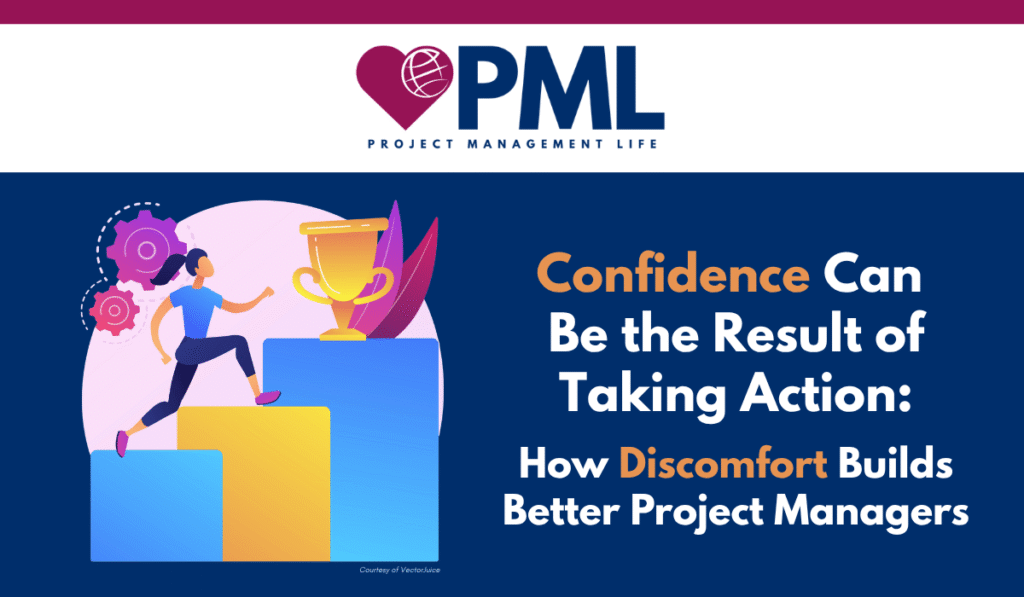

Confidence Can Be the Result of Taking Action: How Discomfort Builds Better Project Managers
There is a side of project management that rarely appears in a project schedule, risk register or status report.
It is the moment when a project manager has to decide whether to step forward before feeling completely ready.
Maybe it is speaking in a meeting with more experienced professionals. Maybe it is having a difficult conversation with a client, taking responsibility for an unfamiliar project, or making a decision when the information is incomplete.
These moments can be uncomfortable. But they can also be where professional capability is built.
Few experiences in my own career taught me this lesson long before I understood how closely it connected to project management.
Finding My Voice
Earlier in my career, I considered myself an introvert. Speaking spontaneously in front of approximately 50 professionals was far outside my comfort zone.
I remember having a simple choice: stay quiet or contribute.
I chose to speak.
It was uncomfortable, and it did not suddenly turn me into a confident public speaker. What it gave me was something more valuable: evidence that I could contribute even when I was nervous.
That experience led to another, then another. Eventually, I found myself speaking and hosting events for audiences of more than 1,000 people.
Looking back, the important transformation was not that I became comfortable speaking to large audiences.
It was that my definition of “I cannot do this” gradually changed.
That distinction matters in project management.
A project manager does not need to be the most experienced person in every room. They do need the ability to communicate, ask questions, facilitate conversations and make sure the right information reaches the right people.
PMI’s Pulse of the Profession 2023 identified communication, problem-solving, collaborative leadership and strategic thinking as four of the most important power skills for project professionals. Communication was identified by 71% of respondents, followed by problem-solving at 68%, collaborative leadership at 65% and strategic thinking at 64%.
These are not simply “soft skills.” They directly influence how project managers work with teams, stakeholders and uncertainty.
Confidence Often Comes After Action
We often think confidence is something we need before taking on a challenge.
My experience has been the opposite.
“Confidence can be the result of taking action.”
You lead your first difficult meeting and discover that you can handle a difficult conversation.
You present an idea to senior stakeholders and learn that you can communicate your thinking clearly.
You take ownership of an unfamiliar problem and discover that you can find the information, involve the right people and work toward a solution.
The experience becomes evidence for the next challenge.
For project managers, this creates a valuable cycle:
Challenge → Action → Learning → Confidence → Greater Responsibility
The cycle does not eliminate nervousness. Instead, it changes our relationship with it.
Preparation Still Matters
Taking one step further should not be confused with taking unnecessary risks.
Project management requires preparation, judgment and knowing when additional expertise is needed.
Before an important meeting, decision or project activity, I try to focus on what I can control:
- Do I understand the information available to me?
- Have I identified the key stakeholders?
- What assumptions am I making?
- What risks or uncertainties should I consider?
- What questions still need to be answered?
- Where do I need input from someone with greater expertise?
- What is the next practical decision?
Once those questions have been addressed, there comes a point when preparation has to turn into action.
That is where professional courage becomes important.
Taking Ownership Before Having the Title
This lesson has also influenced how I approach my career.
When I joined my current construction company as a Project Coordinator, I did not expect that within my first couple of months I would have opportunities to take on Project Manager responsibilities across few projects.
It would have been easy to focus on everything I did not yet know.
Instead, I focused on what I could contribute, where I needed to learn and how I could take ownership of the work in front of me.
Taking ownership did not mean pretending to know everything.
It meant asking questions, learning quickly, communicating clearly and knowing when someone with more experience needed to be involved.
That, to me, is a more useful definition of confidence in project management.
Not:
“I know everything.”
But:
“I may not know everything yet, but I can figure out the next step.”
The project manager’s comfort zone is not the project’s boundary.
The One Step Further
I have learned that some of the most valuable professional growth begins with a very small decision:
Take one step further.
Speak up.
Ask the question.
Take ownership.
Learn the unfamiliar process.
Have the conversation.
Accept the responsibility.
Then learn from what happens.
Project management is ultimately about navigating people, change, uncertainty and competing priorities to create meaningful outcomes. The tools and frameworks matter. So do schedules, budgets, scope, risks and governance.
But behind all of them is a person making decisions, communicating with people and leading through situations that are rarely perfectly certain.
You do not have to feel completely ready to take the next step.
You simply have to be willing to take it!

PML would like to extend a huge thank you to Maria Rangwala for sharing her knowledge and wisdom with the PML community! Learn more about her below and reach out to connect!
About the Author
Maria Rangwala, PMP®, is a Project Coordinator with a Bachelor’s degree in Civil Engineering and hands-on experience in construction project coordination, preconstruction, estimating, procurement, and project delivery. Her interest in project management began during her civil engineering studies, where she became increasingly drawn to the coordination, planning, communication, and problem-solving that bring projects together.
As a Certified Project Management Professional, Maria combines practical construction experience with formal project management principles. Her experience includes residential, commercial, and public-sector projects, giving her a practical perspective on the challenges of delivering projects in dynamic environments.
Maria is passionate about continuous learning and believes that effective project management is ultimately about people. Clear communication, strong stakeholder relationships, early problem-solving, and taking ownership are central to her approach.
As a woman building her career in the construction industry, Maria is also passionate about professional growth and encouraging others to step outside their comfort zones. She believes confidence is often built through action, and that taking on challenges before feeling completely ready can create some of the most valuable opportunities for growth.
Through her writing, Maria shares practical perspectives on project management, construction, career development, and the human side of professional growth.
Interested in becoming a PML Contributor?
Project Management Life (PML) is a volunteer team of 🔥passionate project managers🔥 who believe in the *power of this incredible profession* and we provide our knowledge, guidance, and support to all our project management colleagues within the PML Community.
If you’re interested in:
1️⃣ Growing your personal brand
2️⃣ Sharing your knowledge with your project management colleagues
3️⃣ Supporting the growth of the PML Community and growing our tribal knowledge together
…then we want to hear from you! It’s a win-win-win scenario!
YOU GET FULL CREDIT! We’ll celebrate your contributions, share your socials, etc. so you can grow your personal brand and build up your following as well! Plus you can collect PDUs for your volunteer and content creation hours!
Message us or send us an email at info@projectmanagementlife.org if you’re interested, and let us know! We can’t wait to hear from you!
Who is Project Management Life (PML)?
Project Management Life (PML) is a growing community focused on helping project leaders build sustainable performance through community, content, virtual retreats, courses, and transformational learning experiences.
We share exclusive content around project management, career and personal branding, health and well-being, self-care, and so much more. PML offers a space to connect, recharge, and discover new ways to live your best life.
We founded PML on the idea that we can inspire each other with stories of success and valuable lessons learned, empower each other with career advice and resources to thrive both personally and professionally, and support each other to achieve a fulfilling work-life balance and focus on our health and well-being.
By living our best life, we bring our best selves to our projects, our teams, our loved ones, and the world.
Join the PML Community
The PML Community is a community of project managers and like-minded professionals supporting each other. Whether you’re a new or experienced project manager, this is a place where we can connect, learn, celebrate, and support one another.
The PML Community Newsletter is free, and jam-packed with exclusive content about project management, career growth and personal branding, health and well-being, personal self-improvement, professional development, work-life balance, and more. If you’re ready to go deeper with PML, we also have our PML Membership if you’re looking for more great content to live your best life. Check out our PML Membership page to learn more.
Join us today, and don’t miss out!
Share this Blog Post:
Standard PML Contributor Disclaimer: The views, thoughts, and opinions expressed in this PML Contributor guest post are solely those of the author and may or may not reflect the views of Project Management Life. We appreciate the many diverse perspectives shared by our contributors as part of our commitment to fostering insightful discussions within the PML Tribe Community.
Have you seen PML’s NEW THRIVE™ Magazine?

Recently, we introduced you to THRIVE™, a new magazine resource that supports our mission: to help project professionals thrive both personally
THRIVE™ explores the ideas, stories, people, and resources that help project professionals do more than succeed at work. Inside the inaugural Summer/Fall issue, you’ll find leadership and career insights, sustainable performance, personal branding, community voices, interviews, practical resources, and more.
Check it out and take a moment to give us some feedback. We’d love to hear from you.
Check out some of PML’s other blog posts:
- Boundaries as a Performance Tool: A Sustainable Guide for Neurodivergent Project Managers
- The Invisible Cost of Being the Person Everyone Depends On
- Leading Under Pressure Without Burning Out
- How Project Managers Can Avoid Burnout (Without Sacrificing Performance)
- An Introduction to Sustainable Performance: Why Project Leaders Need a New Way to Think About Performance
- Setting the Year Up for Success: How Project Managers Can Set Personal Goals and Resolutions
- A Thankfulness List for Project Managers
- Celebrating Project Managers: Building the Past, Shaping the Future
- “Great Communicator” is Written on Your Resume – But Does the Hiring Manager Reviewing it Agree?
- Fun Ways to Sneak Exercise into Your Busy Day: Let’s Get Moving, Project Managers!
- The Power of Focus: How Project Managers Get More Done in Less Time and Avoid Burnout
- Leveraging Storytelling: How Your Project Management Resume Can Stand Out and Shine
- Salary Negotiation for Project Managers: How to Not Leave Money on the Table
- Developing a Great Meeting Agenda: A Project Manager’s Essential Tool for Leading Effective Meeting Discussions
- From Chaos to Calm: How Project Managers Can Manage Stress (and Avoid Burnout)
- How to Manage a Project: A Step-by-Step Guide to Leading a Project from Start to Finish
- Smart Snacking: Healthy Snack Options for Busy Project Managers On-the-Move
- Breaking into Project Management: How to Find Your First, Entry-Level Project Manager Role
- The Secrets to a Strong Project Kick-Off Meeting: How to Effectively Launch Your Next Project