
Brought to you from Project Management Life® Founder:
Natalie Berkiw-Scenna, PMP
The Sustainable Workweek: 5 Small Changes That Make a Big Difference
How project leaders can protect their focus, manage their energy, and create a more sustainable way of working.
After more than 25 years working in project management, there’s one thing I know for sure. No matter how well you plan your week, things rarely go exactly as expected.
I can’t begin to tell you how many Mondays I’ve started with a clear set of tasks and every intention of making meaningful progress, only to have those plans quickly disrupted by meetings, unexpected issues, competing demands, chat messages, or someone needing my immediate attention.
And before I know it, it’s Friday yet again. I’ve been incredibly busy all week, but much of the work I intend to accomplish is still sitting on my to-do list.
Have you ever experienced this too?
Over the years, I’ve come to recognize that the challenge isn’t always how much work we have to do. Sometimes, it’s how we approach the work itself.
As project managers, we’re often the ones that everyone turns to for answers, decisions, updates, and problem-solving. We’re constantly balancing the needs of our teams, stakeholders, and organizations, while trying to make progress on our own commitments.
It’s easy to fall into a never-ending cycle of reacting, catching up, and pushing through. And when that becomes our normal way of working, it’s difficult to sustain our performance over time.
That’s where the concept of a sustainable workweek comes in.
What Is a Sustainable Workweek?
A sustainable workweek isn’t about working fewer hours, avoiding challenging assignments, or lowering expectations. It’s about creating a more intentional approach to how we work so that we can consistently deliver meaningful results without sacrificing our health and well-being in the process.
When I began developing the Sustainable Performance Framework™ for Project Leaders, I wanted to challenge the idea that delivering results should require us to constantly operate at full capacity.
I’ve seen how easy it is for high-performing project managers to become so focused on meeting deadlines, supporting their teams, and delivering on commitments that they lose sight of what those demands are costing them.
And I don’t believe we should have to choose between being successful in our careers and maintaining our health and well-being.
For me, Sustainable Performance is about finding a better way to successfully do both.
At Project Management Life, our Sustainable Performance Framework™ focuses on four interconnected elements:
* Attention: Protecting our ability to focus on the work that matters.
* Energy: Managing our physical, mental, and emotional resources.
* Capacity: Being realistic about what we can accomplish with the time and resources available.
* Boundaries: Establishing expectations that protect our time, focus, and well-being.
When our attention is constantly fragmented, our energy suffers. When we consistently overcommit our capacity, maintaining healthy boundaries becomes more difficult. And when boundaries disappear, we often find ourselves working harder just to keep up.
The good news is that creating a more sustainable workweek doesn’t necessarily require a complete overhaul of your calendar or a dramatic change in how you work.
Sometimes, a few small, intentional changes can make a meaningful difference.
Here are five strategies I’ve learned to appreciate over the years.
1. Start Your Week With Priorities, Not Just a To-Do List
One of the biggest traps we fall into is starting our week by looking at everything that needs to get done.
We open our inbox, review our action items, scan our calendars, and immediately begin reacting to the demands in front of us.
But a long to-do list doesn’t necessarily tell us what matters most.
One thing I’ve learned is that being busy and making progress aren’t necessarily the same thing.
It’s easy to spend an entire day responding to emails, attending meetings, updating project documentation, and helping others resolve issues. All of those things may be necessary, but they don’t always move our most important priorities forward.
I’ve found it helpful to ask myself a simple question at the beginning of the week:
If I could only accomplish two or three meaningful things this week, what would they be?
That question helps shift my attention away from everything demanding my time and toward the outcomes that matter most.
Before your week gets underway, consider taking 10–15 minutes to identify the two or three outcomes that would make the greatest difference.
Ask yourself:
* What are the most important results I need to achieve this week?
* What decisions or deliverables will move my projects forward?
* What can wait, be delegated, or be reconsidered?
* Where do I need to spend my attention rather than simply my time?
For project managers, that might mean prioritizing a critical stakeholder decision, resolving a dependency that’s holding up the team, or completing an important project deliverable.
This small shift moves us from managing activity to managing impact.
The goal isn’t to get everything done. It’s to make sure the most important things don’t get lost in everything else.
2. Protect Space for Focused Work
Project management is highly collaborative. Meetings, conversations, decisions, and problem-solving are essential parts of our role.
But there’s a difference between being available to support the project and being constantly accessible to everyone.
I’ve had plenty of days where my calendar was filled with back-to-back meetings, leaving very little time to actually complete the work coming out of those meetings.
And I’ve learned that if I don’t intentionally protect some time for focused work, it’s unlikely that time will magically appear on its own.
When our days are filled with meetings and interruptions, we’re often left trying to squeeze our most important work into the margins of our day. That’s when work starts spilling into evenings, lunch breaks, or weekends.
This doesn’t mean I’m unavailable to my team or unwilling to respond when something genuinely requires my attention. It simply means recognizing that being constantly accessible isn’t always the same as being effective.
Instead of hoping you’ll find time to concentrate, intentionally create it.
Here are a few ways you can start:
* Block one or two periods during the week for work that requires uninterrupted attention.
* Group administrative tasks and email reviews where possible.
* Review recurring meetings to determine which ones still provide value.
* Communicate when you’re unavailable for nonurgent requests.
* Turn off unnecessary notifications during focused work.
Of course, we don’t always control our calendars. Some meetings are mandatory, priorities shift, and certain project environments require us to be more responsive than others.
But I’ve come to recognize that even small windows of protected time can help us make meaningful progress.
Sometimes, one uninterrupted hour accomplishes more than several hours of fragmented attention.
Focus doesn’t happen simply because we have work to do. We need to create the conditions that allow it to happen.
3. Plan for Your Real Capacity, Not Your Ideal Capacity
Have you ever planned your day assuming you’d have eight productive hours available, only to realize that meetings, emails, questions, and unexpected issues consumed most of that time?
I think we’ve all been there.
If there’s one thing I’ve become more conscious of over the years, it’s how often we underestimate the amount of time our existing commitments actually require.
I’ll look at my calendar and think I have a few hours available, but that doesn’t necessarily account for the emails, follow-ups, unexpected conversations, and administrative work that also need to happen.
It’s a reminder that having an open space on my calendar doesn’t automatically mean I have unlimited capacity to take on more work.
Yet we often build our schedules around the time we think we should have rather than the time we realistically have available.
And when our commitments exceed that capacity, we compensate by working faster, multitasking, skipping breaks, or extending our workday.
Instead, try starting with a more realistic view of your available capacity.
Look at your calendar and consider:
* How much time is already committed to meetings?
* What ongoing operational responsibilities require your attention?
* How much flexibility do you need for unexpected issues?
* Where are your realistic windows for meaningful work?
* Are your commitments achievable without consistently working beyond your normal hours?
Don’t forget to include transition time between meetings, administrative activities, and the inevitable interruptions that come with managing projects.
I’ve also learned that when commitments consistently exceed capacity, the answer can’t always be to work longer hours or push harder.
Sometimes, something needs to change.
That might mean adjusting deadlines, clarifying priorities, delegating responsibilities, or having an honest conversation with stakeholders about what’s achievable.
This is especially important for project leaders. We can’t always control the demands placed on us or our teams, but we can make workload constraints visible and help facilitate conversations about priorities and trade-offs.
Capacity planning isn’t about figuring out how to squeeze more into an already full week. It’s about making better decisions about what can realistically be accomplished.
4. Build Recovery Into Your Workday
When workloads increase, breaks are often the first thing we sacrifice.
We eat lunch at our desks, move directly from one meeting to another, and tell ourselves we’ll take a break once things settle down.
But in project management, there’s always something else that needs attention.
I think many of us have been conditioned to believe that taking a break means we’re stepping away from being productive.
I’ve certainly had days where I’ve moved from one meeting to the next, eaten lunch while checking emails, and convinced myself I’d take a break once I finished just one more thing.
But I’ve come to appreciate that taking a few minutes to reset isn’t wasted time.
Sometimes, stepping away from my desk, getting outside for a short walk, or simply giving myself a few minutes between meetings makes a noticeable difference in how I approach the rest of my day.
I’m learning that managing my energy deserves just as much attention as managing my calendar.
A sustainable workweek recognizes that energy is a resource we need to manage, not something we can endlessly draw upon.
And recovery doesn’t always require taking an afternoon off or making a major change to your schedule.
Consider incorporating small moments of recovery throughout your day:
* Take a short walk between meetings or during your lunch break.
* Step away from your screen for a few minutes after intensive work.
* Give yourself time to reset before moving into another demanding conversation.
* Schedule brief breaks following meetings that require significant concentration or emotional energy.
* Pay attention to when your energy is naturally higher or lower throughout the day.
These moments may seem insignificant, but they create opportunities to reset rather than operating at full speed from morning until evening.
Of course, short breaks aren’t a substitute for adequate rest, reasonable workloads, or meaningful time away from work. If you’re consistently exhausted or overwhelmed, a few minutes between meetings won’t solve the underlying problem.
But they can be one part of creating a healthier, more sustainable rhythm.
Recovery shouldn’t be something we earn after we’ve exhausted ourselves. It needs to be part of how we sustain our performance.
5. End Your Week With a Reset, Not Just a Shutdown
For many project managers, Friday becomes a race to close out action items, respond to outstanding messages, and prepare for whatever Monday might bring.
We finish the week physically leaving work, but mentally we’re still carrying everything that remains unresolved.
One habit I’ve found valuable is taking a few minutes at the end of the week to reflect on what actually happened.
Not just what I completed, but what worked, what didn’t, and what I might want to approach differently the following week.
It’s easy to finish Friday thinking about everything that’s still outstanding. But I think it’s equally important to acknowledge what we accomplished, even when the week didn’t go exactly as planned.
And sometimes, the most valuable insight comes from recognizing a pattern that needs to change.
Consider setting aside 10–15 minutes at the end of your week to reflect on three questions.
What moved forward?
Recognize the progress you’ve made, including the decisions, conversations, and small wins that don’t always get reflected on a task list.
In project management, so much of our contribution happens behind the scenes. Resolving issues, supporting colleagues, facilitating decisions, and keeping people aligned are all meaningful accomplishments, even when they don’t result in a completed deliverable.
What needs my attention next week?
Identify unfinished priorities, outstanding decisions, or potential issues that require follow-up.
Capture them somewhere reliable so you don’t have to keep carrying them mentally over the weekend. You don’t need to carry this extra cognitive load with you when you’re trying to unwind.
What needs to change?
Was your calendar overloaded? Were you constantly interrupted? Did you take on responsibilities that could have been shared? Did work repeatedly extend beyond your normal hours?
Use those observations to make one small adjustment for the following week.
I think this last question is especially important.
If every week requires more work than your available capacity allows, that may be a signal that expectations, resources, or ways of working need to change.
Not every challenge can be resolved by becoming more organized or productive.
Sometimes, we need to address the systems and expectations that are contributing to the problem.
The purpose of a weekly reset isn’t to plan a perfect week. It’s to learn from the one you just experienced and approach the next with greater intention.
Small Changes. More Sustainable Results.
After more than 25 years in project management, I know there will always be demanding projects, shifting priorities, and weeks that don’t go according to plan.
I also know that we can’t control everything happening around us.
But I’ve come to believe that we have more opportunities to influence how we work than we sometimes realize.
We can become more intentional about where we direct our attention. We can recognize when our energy needs to be restored. We can be more realistic about our capacity and have conversations when expectations exceed what’s achievable. And we can establish boundaries that allow us to deliver results without constantly sacrificing our own well-being.
Of course, these changes can’t rest entirely on the individual.
Project leaders and organizations also have a responsibility to create environments that support realistic workloads, clear priorities, manageable expectations, and sustainable ways of working.
We can’t expect people to consistently perform at their best when the systems around them require them to operate beyond their limits.
I’m not suggesting that creating a sustainable workweek is easy, or that I’ve mastered every aspect of it myself.
But I do believe that small, intentional changes can add up to meaningful improvements in how we work and how we feel.
And that’s really what Sustainable Performance is about.
Not doing less. Not lowering our standards. But creating a way of working that allows us to continue delivering meaningful results without continually running ourselves into the ground.
Your Sustainable Workweek Challenge
You don’t need to change everything at once.
As you prepare for your next workweek, I’d encourage you to choose just one small action to try:
* Attention: Block one period of uninterrupted focus time for an important priority.
* Energy: Add a short recovery break to your daily calendar.
* Capacity: Review your weekly commitments against your actual available time.
* Boundaries: Communicate one expectation that helps protect your time or focus.
* Reflection: Schedule a 10-minute Friday reset.
Choose one. Practice it for a week. Notice what changes.
Then ask yourself: What’s one small change I can make next week to work more intentionally and sustainably.
Because sustainable performance isn’t built through one major transformation.
It’s built through the everyday choices, habits, and systems that allow us to keep delivering results without continually running ourselves into the ground.
And sometimes, one small change is exactly where sustainable performance begins.

About the Author:
Natalie Berkiw-Scenna, PMP, is the Founder of Project Management Life® (PML), a community and platform dedicated to helping project leaders lead, perform, and live their best life. With a passion for redefining what high performance looks like in today’s demanding work environments, Natalie brings a human-centered approach to modern project leadership that values both results and well-being.
Drawing from 25 years of experience leading complex projects and working with diverse teams, Natalie helps project professionals navigate pressure, complexity, and constant change with greater clarity, resilience, and intention. Her work empowers leaders to move beyond reactive ways of working and toward more sustainable approaches to performance.
Reach out to Natalie on LinkedIn or follow the PML LinkedIn page here.

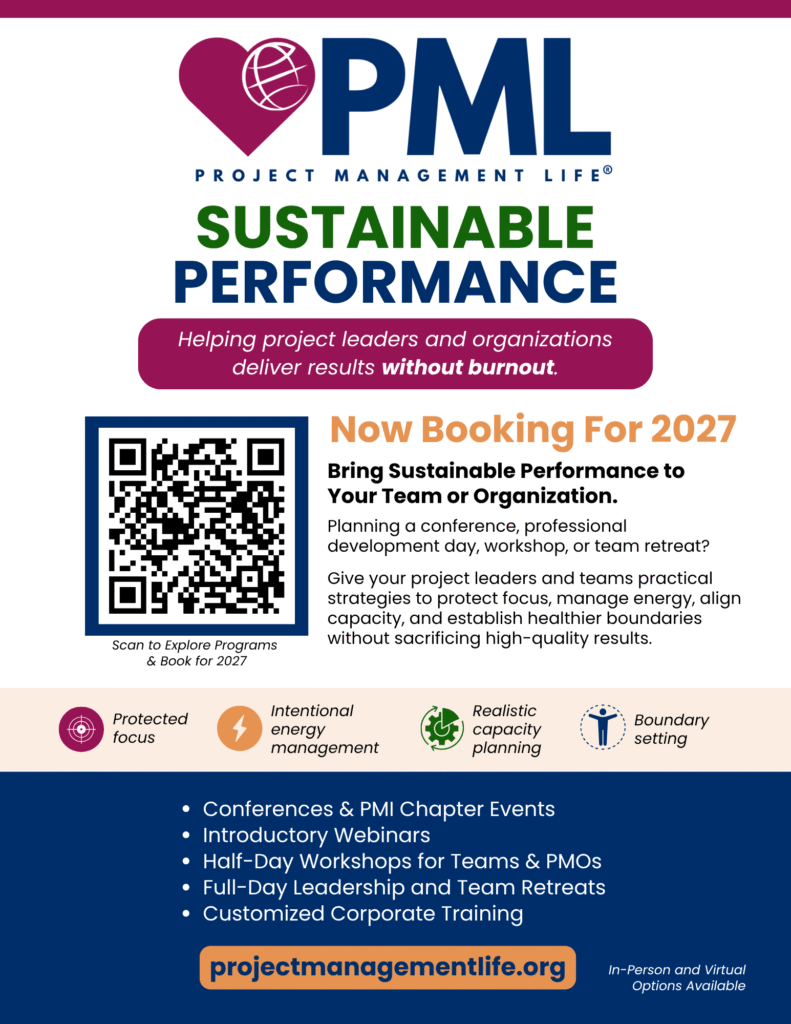
Bring Sustainable Performance to Your Team or Organization
Now Booking for 2027
Project Management Life® offers webinars, lunch-and-learns, keynotes, workshops, and retreats around Sustainable Performance.
We give project leaders and teams practical strategies to protect focus, manage energy, align capacity, and establish healthier boundaries without sacrificing high-quality results.
If you’re interested in learning more about what Sustainable Performance could look like in your organization, visit our Corporate Training page, or schedule a complimentary 30-minute consultation to explore speaking or training session opportunities.
Share this Blog Post:
Check out some of PML’s other blog posts:
- Boundaries as a Performance Tool: A Sustainable Guide for Neurodivergent Project Managers
- The Invisible Cost of Being the Person Everyone Depends On
- Leading Under Pressure Without Burning Out
- How Project Managers Can Avoid Burnout (Without Sacrificing Performance)
- An Introduction to Sustainable Performance: Why Project Leaders Need a New Way to Think About Performance
- Setting the Year Up for Success: How Project Managers Can Set Personal Goals and Resolutions
- A Thankfulness List for Project Managers
- Celebrating Project Managers: Building the Past, Shaping the Future
- “Great Communicator” is Written on Your Resume – But Does the Hiring Manager Reviewing it Agree?
- Fun Ways to Sneak Exercise into Your Busy Day: Let’s Get Moving, Project Managers!
- The Power of Focus: How Project Managers Get More Done in Less Time and Avoid Burnout
- Leveraging Storytelling: How Your Project Management Resume Can Stand Out and Shine
- Salary Negotiation for Project Managers: How to Not Leave Money on the Table
- Developing a Great Meeting Agenda: A Project Manager’s Essential Tool for Leading Effective Meeting Discussions
- From Chaos to Calm: How Project Managers Can Manage Stress (and Avoid Burnout)
- How to Manage a Project: A Step-by-Step Guide to Leading a Project from Start to Finish
- Smart Snacking: Healthy Snack Options for Busy Project Managers On-the-Move
- Breaking into Project Management: How to Find Your First, Entry-Level Project Manager Role
- The Secrets to a Strong Project Kick-Off Meeting: How to Effectively Launch Your Next Project