
Why "Mitigate" is the Most Overused Word in Project Risk Management
Open any risk register and the same word shows up in line after line: mitigate.
Teams write it because it sounds responsible. It fills the response column quickly and makes a register look controlled. But a word that appears everywhere can also be a word that was never truly chosen.
At Forty-Four Risk PM, we are clear on one message: “Mitigation should not be the automatic answer to every risk”.
This article explains why risk teams reach for the word by reflex and how to replace that reflex with a gated framework for choosing among avoid, transfer, accept, and mitigate.
Why Mitigation Becomes a Habit
Part of the problem is built into the language of risk management.
Many definitions describe risk management as the systematic process of identifying, assessing, and mitigating threats or uncertainties. Others define it as the identification, evaluation, and prioritization of risks, followed by the minimization, monitoring, and control of their impact.
Some definitions add risk appetite and describe the process as a way to keep an organization safe from threats beyond its tolerance. When the vocabulary of the discipline leans so heavily on mitigation, project teams naturally start using the word as shorthand for the entire job.
Yet risk management covers far more ground. Risk analysis and risk management let individual risk events and overall risk be understood and managed proactively, optimizing success by minimizing threats and maximizing opportunities and outcomes.
A team that writes mitigate on every row is flattening a rich decision process into a single default action.
The five-step risk management process is meant to move from identifying risks, to analyzing them, to evaluating their severity, to treating them, and then to monitoring and reviewing the results.
Mitigation is only one option inside the treatment step.
The Cost of Defaulting to Mitigation
The habit costs more than vocabulary. When mitigation becomes the default, project teams skip better options and spend resources on risks they could have removed or moved. Three practical problems appear:
- Avoidance is never considered. The team keeps the original plan and tries to reduce a risk that could have been removed by changing the approach. Sometimes I like to call this “Falling in Love With Your Plan”.
- Acceptance is hidden. Some risks fall inside the organization’s risk appetite and should be consciously accepted. Instead, they are labeled mitigate and quietly tolerated without a real plan.
- Actions become vague. Mitigation entries that say monitor or keep an eye on it do not reduce probability or impact in any meaningful way.
Effective business leaders treat risk management as a priority and allocate the time, resources, and attention needed to address potential threats. When that attention is spent on reflexive mitigation, the organization pays for activity rather than for decision-making.
Choose the Right Risk Response with a Gated Framework
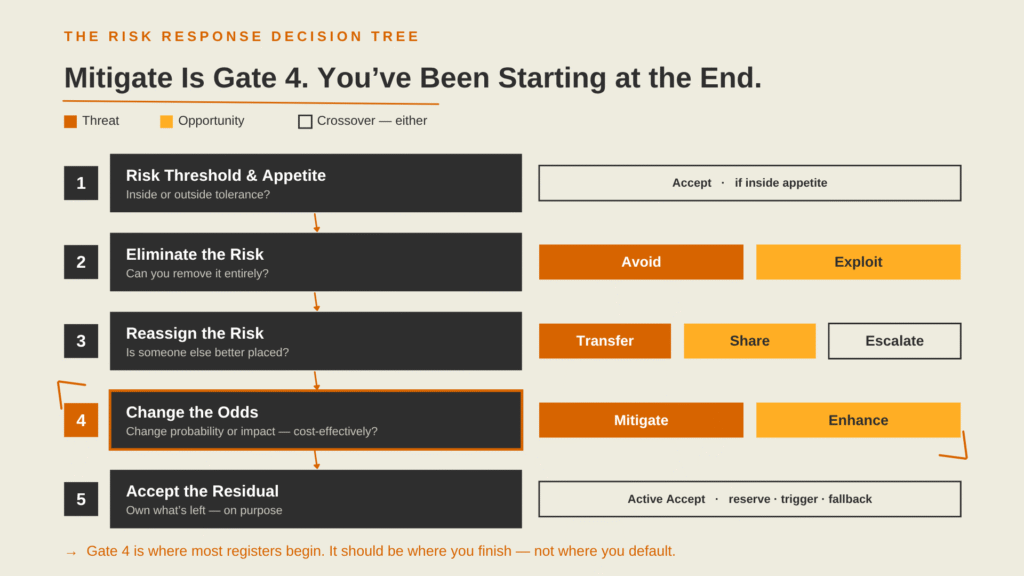
The way out is a fixed sequence of questions. In the five-step process, the treat step is where the response is chosen. Work through the risk register one risk at a time and ask the gates in a set order. The first gate that produces a viable answer determines the response. This framework is simple enough to use in a live risk workshop and structured enough to stop the reflex.
Gate 1: Can You Accept the Risk?
Some risks do not need an action plan. Risks with low probability or low impact, and especially risks that sit within the organization’s risk appetite, can be consciously accepted. Active acceptance is not a decision to ignore a risk. It is an explicit choice to tolerate it, recorded in the register, with a note about the conditions under which it should be reconsidered. If the risk sits beyond the risk appetite, acceptance is not appropriate and should not be used to avoid escalation.
Gate 2: Can You Avoid or Exploit the Risk?
Ask whether the plan can change so the risk no longer applies. Avoidance removes exposure to the threat entirely, and a risk that never materializes requires no further response resources. Teams often skip this gate because they have already attached to the current approach. Asking it first keeps that bias from closing off the cheapest protection available.
Gate 3: Can You Transfer, Share, or Escalate the Risk?
If the risk cannot be avoided cleanly, ask whether another party should own it.
A transfer response moves the risk, or the financial consequence of the risk, to a third party that is better positioned to handle it. Transfer can be accomplished through contractual, financial, or insurance arrangements. It works well when a suitable party exists and the cost of transfer is lower than the expected cost of mitigation. When transfer is chosen, the new owner and the limits of the arrangement should be documented clearly.
Share is when we have an opportunity risk that we want to share the benefits of the risk. This can also be within a contractual or financial arrangement. And it work well when you need both parties to ensure the risk will happen.
When a risk response sits outside the authority of the current level, the risk can be escalated to the next level. This is not to be used as a way to push the responsibility, but a way to put the risk at the risk at the right level for decisions and response planning.
Gate 4: Does Mitigation or Enhance Earn Its Place?
Mitigation is the right response when the first three gates do not produce a better answer.
At this point the risk is real, the project owns it, and active treatment is appropriate. Mitigation should take the form of a specific action that reduces probability, reduces impact, or does both.
A useful mitigation entry names the action, the owner, the timeline, and a measurable target. A general instruction to monitor is not mitigation.
Monitoring belongs with acceptance and with the ongoing review of the risk process.
Gate 5: Actively Accept the Residual
Sometimes, we need to accept the residuals of our risks.
Gate 5 means that we have looked at all the other options and probably even implemented some of them, but a residual amount of risk is left over. When this happens, we need to ensure we are actively prepared to respond to those risks by taking them back through the gates.
Occasionally, the residual we have left over is within our appetite, meaning we can now accept the risk, ensuring we keep all necessary reserves, triggers, and fallback plans in place in case the risk does materialize.
This is not a failure of your work in Gates 1-4, but just what is left over from the actions you did at each gate and how you plan to respond against the residual.
Run the Gates in Your Next Risk Workshop
The framework works best as a structured segment of a regular risk review.
Put the gate questions on a slide or handout and work through the register line by line. Ask the risk owner to state a decision at each gate before moving to the next question.
Do not allow mitigate to be written down until the team has explained why avoid, transfer, and accept were not selected.
Keep the recorded decision short. One line of rationale next to each response makes the thinking visible to sponsors, auditors, and future project teams. It also prevents the same risk from being relabeled mitigation in the next cycle without discussion.
During the monitor and review step, revisit old decisions.
Risks change, the organization’s risk appetite changes, and new transfer options can appear.
A mitigation action that gets carried forward month after month without being questioned is exactly the reflex this framework is designed to break.
Mitigation Is Earned, Not Assumed
When mitigation is chosen through the gates, the word regains its meaning.
The risk register then communicates not just what the team will do, but why that action beats the alternatives. That shift improves stakeholder conversations and builds a stronger risk culture over time.
44Risk PM helps project and risk professionals build these habits through practical training and workshop facilitation. Bring the gate questions to your next risk review and let mitigation earn its place in every decision.
Frequently Asked Questions
What is the risk management process?
The standard risk management process covers five steps: plan risk management, identify risks, analyze them, respond to the risks, and monitor and close out the risks.
The framework in this article belongs to the risk response step, where project teams decide whether to avoid, transfer, accept, or mitigate their threats and opportunities. After the response is selected, monitoring should verify that the response is working as intended.
Why is mitigate overused in risk management?
Mitigate is overused because it is the first word people reach for when they need to show that a risk was handled.
Definitions of risk management often describe the discipline as identifying, assessing, and mitigating threats, which makes mitigation sound like the core of the job. Many teams also believe writing a mitigation action is safer than admitting that a risk was accepted. In practice, mitigation should be chosen only after avoidance, transfer, and acceptance have been evaluated.
What is the difference between the risk response strategies?
For Threats:
Avoid changes the project plan so the risk no longer applies.
Transfer moves ownership of the risk or its financial impact to a third party.
Mitigate reduces the probability or impact through proactive actions.
For Opportunities:
Exploit changes the project plan so we can ensure the risk actually happens.
Share shifts the ownership or financial impact in a way to share the benefits with a third party.
Enhance increases the probability or impact through proactive actions.
For Both:
Accept is a deliberate decision to tolerate a risk that falls within the organization’s risk appetite, with monitoring in place.
Escalate is a push of the risk to a higher entity (Program, Portfolio) to get the risk at the right level of decision making and authority to handle it.
The right response depends on the risk and its context. A gated framework helps project teams weigh each option instead of defaulting to mitigation.
Is mitigation always the best risk response for threats?
No. Mitigation is only one of four main responses to threats, and it can be the most resource-intensive choice.
If a risk can be avoided by changing the plan, avoidance is usually better.
If a third party can take on the risk through transfer, that may be more efficient.
If the risk sits below the risk appetite, it can be consciously accepted.
Mitigation becomes the right answer only when those earlier options are not available or not appropriate.

PML would like to extend a huge thank you to Russell Parker for sharing his knowledge and wisdom with the PML community! Learn more about him below and reach out to connect!
About the Author
Russ Parker
Major, US Marine Corps Retired
Owner, Forty-Four Risk PM, LLC
PMP®, PMI-RMP®, PMI-ACP®, CPMAI™
PMI-Authorized Training Partner Instructor for the PMP®, PMI-RMP®, CPMAI™
Russ Parker is a retired U.S. Marine Corps Officer and one of the emerging authorities in project risk management. As the owner of 44Risk PM, LLC and the creator behind “The Bearded Risk PM” YouTube channel, Russ teaches project managers how to elevate their risk maturity with clear, practical methods grounded in real project environments.
He holds the PMP®, PMI-RMP®, CPMAI™, and the PMI-ACP® certifications and serves as a PMI-ATP Instructor for the PMP®, PMI-RMP®, and CPMAI™. Russ likes to blend his high-stakes military planning experience with deep PMI-aligned expertise, helping teams move beyond checkbox risk processes toward proactive, strategic risk leadership.
Originally from Cleveland, Ohio and now based in bright and sunny St. Augustine, Florida, he brings clarity, authenticity, and mission-focused teaching to every event
Interested in becoming a PML Contributor?
Project Management Life (PML) is a volunteer team of 🔥passionate project managers🔥 who believe in the *power of this incredible profession* and we provide our knowledge, guidance, and support to all our project management colleagues within the PML Community.
If you’re interested in:
1️⃣ Growing your personal brand
2️⃣ Sharing your knowledge with your project management colleagues
3️⃣ Supporting the growth of the PML Community and growing our tribal knowledge together
…then we want to hear from you! It’s a win-win-win scenario!
YOU GET FULL CREDIT! We’ll celebrate your contributions, share your socials, etc. so you can grow your personal brand and build up your following as well! Plus you can collect PDUs for your volunteer and content creation hours!
Message us or send us an email at info@projectmanagementlife.org if you’re interested, and let us know! We can’t wait to hear from you!

Who is Project Management Life (PML)?
Project Management Life (PML) is a growing community focused on helping project leaders build sustainable performance through community, content, virtual retreats, courses, and transformational learning experiences.
We share exclusive content around project management, career and personal branding, health and well-being, self-care, and so much more. PML offers a space to connect, recharge, and discover new ways to live your best life.
We founded PML on the idea that we can inspire each other with stories of success and valuable lessons learned, empower each other with career advice and resources to thrive both personally and professionally, and support each other to achieve a fulfilling work-life balance and focus on our health and well-being.
By living our best life, we bring our best selves to our projects, our teams, our loved ones, and the world.
Join the PML Community
The PML Community is a community of project managers and like-minded professionals supporting each other. Whether you’re a new or experienced project manager, this is a place where we can connect, learn, celebrate, and support one another.
The PML Community Newsletter is free, and jam-packed with exclusive content about project management, career growth and personal branding, health and well-being, personal self-improvement, professional development, work-life balance, and more. If you’re ready to go deeper with PML, we also have our PML Membership if you’re looking for more great content to live your best life. Check out our PML Membership page to learn more.
Join us today, and don’t miss out!
Share this Blog Post:
Standard PML Contributor Disclaimer: The views, thoughts, and opinions expressed in this PML Contributor guest post are solely those of the author and may or may not reflect the views of Project Management Life. We appreciate the many diverse perspectives shared by our contributors as part of our commitment to fostering insightful discussions within the PML Tribe Community.
Have you seen PML’s NEW THRIVE™ Magazine?

Recently, we introduced you to THRIVE™, a new magazine resource that supports our mission: to help project professionals thrive both personally
THRIVE™ explores the ideas, stories, people, and resources that help project professionals do more than succeed at work. Inside the inaugural Summer/Fall issue, you’ll find leadership and career insights, sustainable performance, personal branding, community voices, interviews, practical resources, and more.
Check it out and take a moment to give us some feedback. We’d love to hear from you.
Check out some of PML’s other blog posts:
- Boundaries as a Performance Tool: A Sustainable Guide for Neurodivergent Project Managers
- The Invisible Cost of Being the Person Everyone Depends On
- Leading Under Pressure Without Burning Out
- How Project Managers Can Avoid Burnout (Without Sacrificing Performance)
- An Introduction to Sustainable Performance: Why Project Leaders Need a New Way to Think About Performance
- Setting the Year Up for Success: How Project Managers Can Set Personal Goals and Resolutions
- A Thankfulness List for Project Managers
- Celebrating Project Managers: Building the Past, Shaping the Future
- “Great Communicator” is Written on Your Resume – But Does the Hiring Manager Reviewing it Agree?
- Fun Ways to Sneak Exercise into Your Busy Day: Let’s Get Moving, Project Managers!
- The Power of Focus: How Project Managers Get More Done in Less Time and Avoid Burnout
- Leveraging Storytelling: How Your Project Management Resume Can Stand Out and Shine
- Salary Negotiation for Project Managers: How to Not Leave Money on the Table
- Developing a Great Meeting Agenda: A Project Manager’s Essential Tool for Leading Effective Meeting Discussions
- From Chaos to Calm: How Project Managers Can Manage Stress (and Avoid Burnout)
- How to Manage a Project: A Step-by-Step Guide to Leading a Project from Start to Finish
- Smart Snacking: Healthy Snack Options for Busy Project Managers On-the-Move
- Breaking into Project Management: How to Find Your First, Entry-Level Project Manager Role
- The Secrets to a Strong Project Kick-Off Meeting: How to Effectively Launch Your Next Project