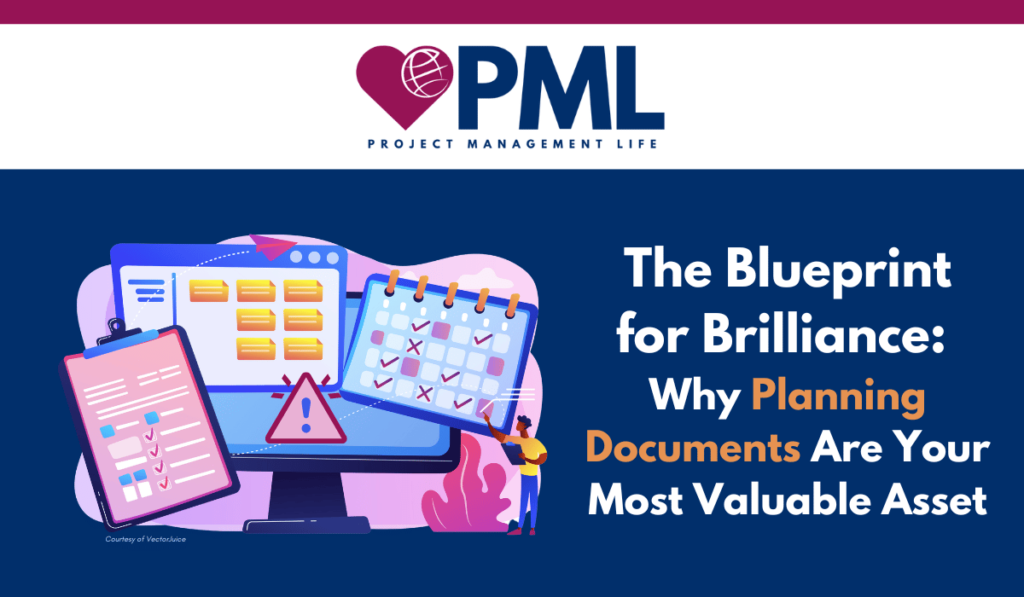

The Blueprint for Brilliance: Why Planning Documents Are Your Project's Most Valuable Asset
In the dynamic world of project management, we’re often tempted to see the plan as a static artifact—a set of documents to be filed away once the real work begins. We rush to the Gantt chart, eager to see the dates and dependencies, but we miss the most important part of the planning process: the foundational documents that transform an idea into an executable reality.
This is a lesson I learned firsthand during a critical system migration project. We had a flawless technical plan and all the tools in place, but user adoption was plummeting. We were hitting every milestone, but the end users were frustrated, and our feedback was overwhelmingly negative. The ‘fix’ wasn’t a new line of code; it was a renewed human connection. By setting aside the technical plan and simply listening to the frontline users, we uncovered deep-seated anxieties and critical pain points our scope had entirely missed. That moment taught me that while the plan is the brain of a project, empathy and connection are its heart.
Great planning isn’t about perfection; it’s about creating a living blueprint that drives execution, aligns teams, and builds a shared sense of ownership. A great plan doesn’t just tell you what to do—it tells you why it matters, how to do it, and who is accountable. This is where your core planning documents—the Project Charter, SOW, WBS, and Risk Register—become your most valuable tools. They are the scaffolding that turns a concept into confidence.
1. The ‘Why’: The Project Charter & Statement of Work (SOW)
Before you can build anything, you must define its purpose. The Project Charter is your single-page declaration of intent. It is the formal authorization that gives the project manager the authority to proceed and use organizational resources. In my experience, this document is what enables the team to rally around a common vision. For example, when I led the implementation of over 15 construction projects at Wakwetu General Stores, the project charter was our North Star, ensuring every stakeholder from architects to engineers was aligned on the same purpose, which was critical for a 100% on-schedule and on-budget delivery.
The Statement of Work (SOW) takes this a step further, detailing the project’s specific deliverables, timelines, and acceptance criteria. It moves the conversation from the abstract ‘what’ to the concrete ‘what success looks like.’ The SOW is your contract with yourself and your team, a clear agreement that leaves no room for ambiguity. This isn’t just about documentation; it’s about building a shared understanding that is critical for team alignment and stakeholder buy-in.
2. The ‘How’: Work Breakdown Structure (WBS) & The Gantt Chart
Once the ‘why’ is clear, you need to structure the ‘how.’ The Work Breakdown Structure (WBS) is a hierarchical, deliverable-oriented decomposition of the work to be executed. It’s the blueprint that ensures every piece of the puzzle is accounted for. The beauty of a WBS is its focus on the outputs, not just the activities. For example, during a fintech implementation project, a well-defined WBS allowed my team to break down the complex tasks of system integration and user training into manageable work packages, which helped us improve team productivity by 31%. This disciplined approach uncovers hidden tasks and ensures nothing is overlooked.
Only after you have a complete WBS should you turn to the Gantt chart. While the WBS defines what you’re building, the Gantt chart provides the time-based visualization of when you’ll build it. It maps out dependencies, assigns resources, and tracks progress. The combination of a detailed WBS and a dynamic Gantt chart provides a powerful one-two punch for execution—one ensures you have a complete picture of the scope, and the other gives you the tools to manage the schedule and resources required to deliver it.
3. The ‘What If’: The Risk Register
Every project has risks, but how you plan for them is what separates good project managers from great leaders. The Risk Register is not just a list of potential problems; it is a tool for building team confidence. By proactively identifying, analyzing, and planning mitigation strategies for risks, you transform uncertainty into a manageable challenge.
A well-maintained risk register shows your team that you’ve anticipated potential obstacles and have a plan to navigate them. This builds trust and encourages a culture where problems are surfaced early instead of being hidden until they become crises. This approach was crucial in a recent high-stakes project simulation where I remotely led a team of 10 project managers to achieve an impressive 92% completion rate for a Google Global Careers event. The risk register was our anchor, allowing us to pivot quickly and proactively solve problems before they could derail the project. It shifts the conversation from ‘Why didn’t you foresee this?’ to ‘This is an interesting new risk, what’s our plan?’
Final Thoughts: From Clarity to Confidence
Great planning documents don’t just sit on a server; they are active tools that you return to, update, and use to guide your decisions. They are the backbone of a project, transforming a vague idea into a roadmap that everyone can understand and believe in. The real magic of these documents isn’t in their perfect structure but in the conversations they facilitate. They invite debate, force alignment, and build a sense of collective ownership. They are the physical manifestation of your team’s collective intelligence, turning clarity into the confidence required for brilliant execution.
What are the foundational planning documents you can’t live without, and what ‘unscripted’ lessons have they taught you about project success?

PML would like to extend a huge thank you to Dan Alwende for sharing his knowledge and wisdom with the PML community! Learn more about him below and reach out to connect!
About the Author
Dan Alwende, PMP®, CSPO®, is a seasoned Program and Project Manager with over a decade of experience driving operational excellence and strategic impact across banking, ICT, and construction sectors. Passionate about the intersection of human-centric leadership and technological innovation, Dan specializes in leveraging AI and automation to transform complex projects, streamline processes, and foster thriving teams. He has a proven track record of consistently achieving on-schedule and on-budget delivery and is dedicated to empowering Project Managers to lead with greater clarity, foresight, and value in the evolving digital landscape. His volunteer work with the Project Management Institute (PMI) Kenya Chapter, The UN Volunteers, and The PM Playbook further underscores his commitment to the Project Management profession.
Connect with Dan on LinkedIn at: https://www.linkedin.com/in/dan-alwende/
Interested in becoming a PML Contributor?
Project Management Life (PML) is a volunteer team of 🔥passionate project managers🔥 who believe in the *power of this incredible profession* and we provide our knowledge, guidance, and support to all our project management colleagues within the PML Tribe.
If you’re interested in:
1️⃣ Growing your personal brand
2️⃣ Sharing your knowledge with your project management colleagues
3️⃣ Supporting the growth of the PML Community and growing our tribal knowledge together
…then we want to hear from you! It’s a win-win-win scenario!
YOU GET FULL CREDIT! We’ll celebrate your contributions, share your socials, etc. so you can grow your personal brand and build up your following as well! Plus you can collect PDUs for your volunteer and content creation hours!
Message us or send us an email at info@projectmanagementlife.org if you’re interested, and let us know! We can’t wait to hear from you!
Who is Project Management Life (PML)?
Project Management Life (PML) is a team of passionate project managers who believe in the power of this incredible profession and provide our knowledge, guidance, and support to our colleagues.
We know that project managers are often the unsung heroes that drive innovation and progress, and bring calm to what might otherwise be chaos. We are the leaders behind the scenes that work tirelessly, and deserve to be celebrated for our incredible efforts in making the world a better place.
We founded PML on the idea that we can inspire each other with stories of success and valuable lessons learned, empower each other with career advice and resources to thrive both personally and professionally, and support each other to achieve a fulfilling work-life balance by focusing on our health and well-being.
By living our best life, we bring our best selves to our projects, our teams, and the world.
We truly believe that project managers change the world.
Join the PML Tribe Community
The PML Tribe Community is a growing online community of project managers supporting our fellow project managers. Whether you’re a new or experienced project manager, this is a place where we can connect, learn, celebrate, and support one another.
Membership is free, and you get access to a weekly, members-only newsletter that is jam-packed with exclusive and curated content about project management, career growth and personal branding, health and well-being, personal self-improvement, professional development, work-life balance, and more. We are also launching an invite-only community forum, an exclusive clothing brand just for us called PML Tribal Gear, various PML podcasts, health and wellness classes, and so much more.
Join us today, and don’t miss out!
Share this Blog Post:
Check out some of PML’s other recent blog posts!
- “Great Communicator” is Written on Your Resume – But Does the Hiring Manager Reviewing it Agree?
- Fun Ways to Sneak Exercise into Your Busy Day: Let’s Get Moving, Project Managers!
- The Power of Focus: How Project Managers Get More Done in Less Time and Avoid Burnout
- Leveraging Storytelling: How Your Project Management Resume Can Stand Out and Shine
- Salary Negotiation for Project Managers: How to Not Leave Money on the Table
- Developing a Great Meeting Agenda: A Project Manager’s Essential Tool for Leading Effective Meeting Discussions
- From Chaos to Calm: How Project Managers Can Manage Stress (and Avoid Burnout)
- How to Manage a Project: A Step-by-Step Guide to Leading a Project from Start to Finish
- Smart Snacking: Healthy Snack Options for Busy Project Managers On-the-Move for Project Managers
- Breaking into Project Management: How to Find Your First, Entry-Level Project Manager Role
- The Secrets to a Strong Project Kick-Off Meeting: How to Effectively Launch Your Next Project