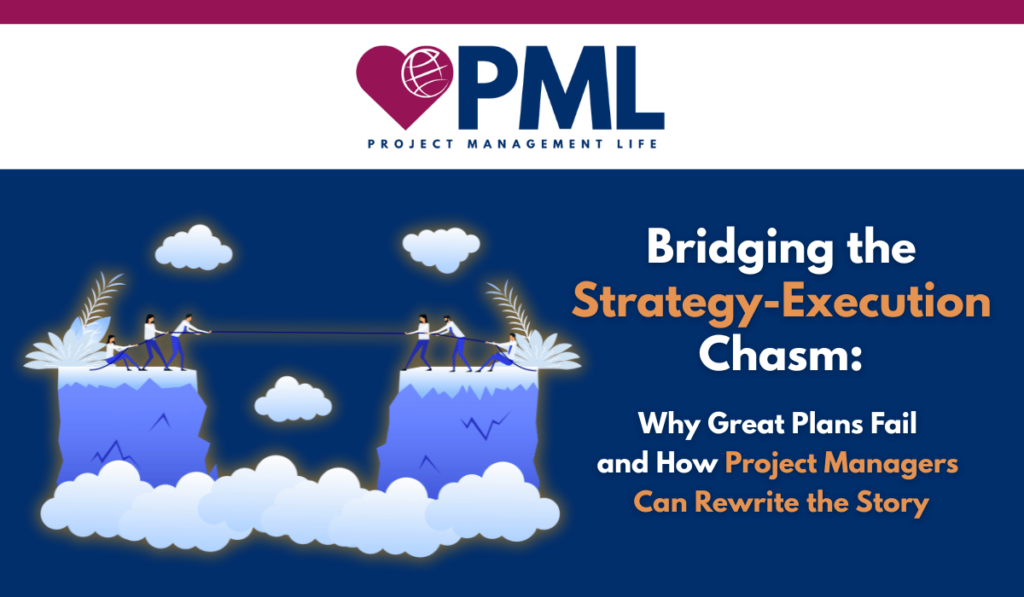

Bridging the Strategy-Execution Chasm: Why Great Plans Fail and How Project Managers Can Rewrite the Story
Most companies don’t fail because of poor strategy—they fail because the strategy never makes it off the boardroom slides.
Here’s how project managers can become the bridge between vision and reality.
Every organisation loves to talk strategy. Leaders craft inspiring visions, bold roadmaps, and ambitious targets. Yet, year after year, the majority of those strategies never translate into real outcomes. They remain words on slides, not results in the market.
This disconnect is what we call the strategy-execution chasm. A dangerous gap where even the most brilliant plans fall apart. Companies invest billions in digital transformation, new product lines, and growth initiatives, only to find themselves stuck in execution paralysis.
Having led global initiatives and transformation projects, I’ve seen this chasm up close. And the reality is clear: success today is less about having the “right” strategy and more about ensuring that strategy gets executed well.
The Strategy-Execution Chasm in Reality:
From research and direct experience, I’ve seen the same recurring challenges emerge when strategies fail to translate into execution. What makes them more concerning is that these challenges aren’t abstract—they’ve played out in real projects I’ve managed.
Vision-Reality Disconnect
Many organisations set ambitious goals but fail to break them into actionable, measurable
outcomes. I recall one project where the objective was to improve processes so the client
received more tangible value. While leadership was aligned, the team itself wasn’t. Everyone
worked on their tasks, but without connecting back to the bigger picture, execution lacked
coherence and impact.
Departmental Silos
Cross-functional collaboration should drive transformation, but too often, teams work in
isolation. In one initiative, functions operated as though they were running separate projects.
Despite individual excellence, the absence of collective alignment created imbalance—and
progress slowed.
Accountability Gaps
Without clearly defined roles and responsibilities, accountability becomes blurred. I’ve been in situations where deadlines slipped and deliverables stalled because no one could be held responsible. In escalation calls, everyone agreed “something must be done,” yet no one owned the outcome. Progress turned into a cycle of finger-pointing.
Communication Breakdown
Strategies often thrive in the boardroom but vanish in execution. I’ve seen stakeholders nod in agreement during steering committee meetings, only to abandon those commitments once the meeting ended. Without consistent reinforcement, strategies lived in slide decks, not in daily operations.
Resource Misalignment
Critical initiatives often lack the right people. I’ve led projects where sponsors emphasized urgency, but resources were allocated based on availability, not suitability. Teams already stretched thin were asked to drive transformation, creating bottlenecks from the outset.
Adaptability Issues
Change is inevitable, but resistance is common. In several projects, when scope or direction shifted, team members resisted new ways of working. Without effective change management, adaptability became a barrier, slowing adoption and delaying outcomes.
These experiences taught me that the strategy-execution chasm isn’t just a process gap—it’s a misalignment problem. Misalignment of goals, accountability, communication, resources, and adaptability. Unless addressed holistically, even the most visionary strategies will collapse under their own weight.
How can this be solved?
This is where project managers can play a transformative role. We are not just schedulers or status reporters—we are strategic integrators, responsible for ensuring that strategy survives its first contact with execution.
To achieve this, we must combine leadership, structure, and adaptability. In practice, that means:
1. Clarify the “Why” – Anchor teams to the purpose behind the initiative. People deliver better when they understand the impact of their work.
2. Translate Strategy Into Execution – Break abstract goals into milestones, measurable outcomes, and day-to-day deliverables. Tools like OKRs, Agile roadmaps, and Balanced Scorecards are invaluable here.
3. Facilitate Alignment Across Functions – Establish governance models and cross-functional forums where decisions are made collectively, reducing silos and duplication of effort.
4. Build Accountability Structures – Define ownership with tools like RACI matrices, and establish transparent reporting. When accountability is shared and visible, progress accelerates.
5. Align Resources Early – Secure the right people and ensure capacity is available. Assign resources based on skills and criticality, not just availability.
6. Implement Continuous Communication – Move beyond the one-time “launch.” Reinforce strategy through transparent dashboards, storytelling, and frequent updates that keep it alive across all levels of the organization.
7. Champion Adaptability and Change Management – Normalize change as part of culture. Support teams through scope changes or pivots with empathy, training, and strong communication.
8. Leverage Technology for Visibility – Use project management software and data-driven dashboards to provide real-time transparency—but remember, tools are only enablers. True alignment comes from leadership and collaboration.
By stepping into these roles, project managers shift from simply managing timelines to driving strategic outcomes. We become the bridge between vision and reality, the enablers who ensure strategies don’t stall but translate into tangible, measurable results.
The strategy-execution chasm is real, and I’ve seen it unfold too often. Organizations don’t fail because they lack vision; they fail because execution isn’t built to support that vision. As project managers, we have the unique opportunity to become the architects of
alignment—the ones who ensure strategies don’t die in PowerPoint but live in customer outcomes.
The next time you hear about a bold new company strategy, ask the real question: “Who will bridge the gap?”
The answer should be: Project Managers.

PML would like to extend a huge thank you to Suhas Ramesh for sharing his knowledge and wisdom with the PML community! Learn more about him below and reach out to connect!
About the Author
Connect with Suhas on LinkedIn at: https://www.linkedin.com/in/suhas-ramesh/
Check out his Medium page at: https://medium.com/@suhas.ramesh
Or visit his Substack at: https://substack.com/@ramsuh
Interested in becoming a PML Contributor?
Project Management Life (PML) is a volunteer team of 🔥passionate project managers🔥 who believe in the *power of this incredible profession* and we provide our knowledge, guidance, and support to all our project management colleagues within the PML Tribe.
If you’re interested in:
1️⃣ Growing your personal brand
2️⃣ Sharing your knowledge with your project management colleagues
3️⃣ Supporting the growth of the PML Community and growing our tribal knowledge together
…then we want to hear from you! It’s a win-win-win scenario!
YOU GET FULL CREDIT! We’ll celebrate your contributions, share your socials, etc. so you can grow your personal brand and build up your following as well! Plus you can collect PDUs for your volunteer and content creation hours!
Message us or send us an email at info@projectmanagementlife.org if you’re interested, and let us know! We can’t wait to hear from you!

Who is Project Management Life (PML)?
Project Management Life (PML) is a team of passionate project managers who believe in the power of this incredible profession and provide our knowledge, guidance, and support to our colleagues.
We know that project managers are often the unsung heroes that drive innovation and progress, and bring calm to what might otherwise be chaos. We are the leaders behind the scenes that work tirelessly, and deserve to be celebrated for our incredible efforts in making the world a better place.
We founded PML on the idea that we can inspire each other with stories of success and valuable lessons learned, empower each other with career advice and resources to thrive both personally and professionally, and support each other to achieve a fulfilling work-life balance by focusing on our health and well-being.
By living our best life, we bring our best selves to our projects, our teams, and the world.
We truly believe that project managers change the world.
Join the PML Tribe Community
The PML Tribe Community is a growing online community of project managers supporting our fellow project managers. Whether you’re a new or experienced project manager, this is a place where we can connect, learn, celebrate, and support one another.
Membership is free, and you get access to a weekly, members-only newsletter that is jam-packed with exclusive and curated content about project management, career growth and personal branding, health and well-being, personal self-improvement, professional development, work-life balance, and more. We are also launching an invite-only community forum, an exclusive clothing brand just for us called PML Tribal Gear, various PML podcasts, health and wellness classes, and so much more.
Join us today, and don’t miss out!
Share this Blog Post:
Standard PML Contributor Disclaimer: The views, thoughts, and opinions expressed in this PML Contributor guest post are solely those of the author and may or may not reflect the views of Project Management Life. We appreciate the many diverse perspectives shared by our contributors as part of our commitment to fostering insightful discussions within the PML Tribe Community.
Check out some of PML’s other recent blog posts!
- “Great Communicator” is Written on Your Resume – But Does the Hiring Manager Reviewing it Agree?
- Fun Ways to Sneak Exercise into Your Busy Day: Let’s Get Moving, Project Managers!
- The Power of Focus: How Project Managers Get More Done in Less Time and Avoid Burnout
- Leveraging Storytelling: How Your Project Management Resume Can Stand Out and Shine
- Salary Negotiation for Project Managers: How to Not Leave Money on the Table
- Developing a Great Meeting Agenda: A Project Manager’s Essential Tool for Leading Effective Meeting Discussions
- From Chaos to Calm: How Project Managers Can Manage Stress (and Avoid Burnout)
- How to Manage a Project: A Step-by-Step Guide to Leading a Project from Start to Finish
- Smart Snacking: Healthy Snack Options for Busy Project Managers On-the-Move for Project Managers
- Breaking into Project Management: How to Find Your First, Entry-Level Project Manager Role
- The Secrets to a Strong Project Kick-Off Meeting: How to Effectively Launch Your Next Project
Support PML and Wear Your Project Management Pride!
Disclosure: This article may provide links to products or services that PML feels would be beneficial to our fellow project management colleagues and friends. In some cases, PML may be compensated for purchases made, at no cost to you. This is used to support the growth of the PML Tribe community and website, and we promise to continue to provide valuable content as we grow.