Brought to you by PML Founder, Natalie Berkiw-Scenna, PMP
How Project Managers Can Avoid Burnout (Without Sacrificing Performance)
Project managers have a reputation for getting things done.
We lead teams through ambiguity, manage competing priorities, and deliver results in environments that are often fast-paced and high-pressure. On the surface, it can look like we’re in control… organized, capable, and always moving things forward.
But behind the scenes, many project managers are running on empty.
Burnout in project management isn’t rare. In fact, it’s predictable. And perhaps more importantly, it’s preventable.
The challenge is that most advice around burnout focuses on surface-level fixes like “take a break”, set boundaries, practice self-care. While those things matter, they don’t address the deeper issue. Burnout isn’t simply the result of working too hard. It’s the result of working in a way that isn’t sustainable.
Why Project Managers Are Especially Vulnerable
There is something uniquely demanding about the role of a project manager. You sit at the center of everything, yet often operate without direct authority. You are expected to deliver outcomes while navigating shifting priorities, limited resources, and diverse stakeholder expectations.
At any given moment, you may be managing timelines, resolving conflicts, responding to urgent requests, and thinking three steps ahead. That constant context switching alone is mentally exhausting. Layer on top of that the emotional labor of managing pressure, absorbing stress, and keeping teams aligned and it becomes clear why burnout is so common in this profession.
It’s not just the volume of our work. It’s the cognitive and emotional load that comes with it.
Burnout Doesn’t Always Look Like Burnout
One of the most challenging aspects of burnout is that it doesn’t always show up in obvious ways. It’s not just physical exhaustion or the need for a vacation. For many project managers, burnout is quieter and more gradual.
It can feel like decision fatigue creeping into your day, where even small choices require more effort than they used to. It can show up as a sense of detachment from your work or a loss of motivation for projects that once energized you. You may notice your confidence slipping, even though your experience hasn’t changed, or find yourself feeling increasingly frustrated with stakeholders and team dynamics.
Perhaps most deceptively, you may still be delivering. Deadlines are met, meetings are attended, and expectations appear to be fulfilled. But internally, it feels harder. Heavier. Less sustainable.
That’s often the turning point and the warning sign.
Understanding the Real Causes of Burnout
Burnout is often misunderstood as a personal issue, something that can be solved with better habits or more resilience. In reality, it is usually the result of a combination of structural, behavioral, and cultural factors.
From a structural perspective, many project managers operate within environments defined by unrealistic timelines, constrained resources, and evolving expectations. Even the most skilled professional will struggle to sustain performance under those conditions indefinitely.
Behaviorally, high-performing project managers often contribute to their own overload without realizing it. The desire to prove value can lead to overcommitting. A strong sense of ownership can make delegation feel uncomfortable. Perfectionism can turn simple deliverables into time-consuming efforts that drain energy.
Culturally, many organizations reinforce burnout without intending to. There is often an unspoken expectation to always be available, to respond quickly, and to “step up” when things get difficult. Over time, this creates a cycle where overwork is normalized and even rewarded.
When these factors intersect, burnout becomes less of a possibility and more of an inevitability.
The Burnout Cycle
Burnout doesn’t happen all at once. It builds over time in a pattern that many project managers will recognize.
It often begins with capability. You take on more because you can. You’re reliable, adaptable, and willing to step in where needed. As a result, expectations increase. More responsibility is placed on your shoulders, and your role begins to expand.
Gradually, boundaries start to blur. You respond to messages earlier, stay online later, and say yes more often than you say no. At first, it feels manageable. But over time, your energy begins to decline.
As your energy drops, maintaining the same level of performance requires more effort. To compensate, you work longer hours or push harder, believing it’s temporary. Instead of solving the problem, it accelerates the cycle.
Without intervention, this pattern continues until burnout fully sets in.
Shifting to Sustainable Performance
Avoiding burnout doesn’t require lowering your standards or doing less meaningful work. It requires a shift in how you approach performance altogether.
Traditional project management often emphasizes responsiveness, availability, and output at all costs.
Sustainable performance, on the other hand, is rooted in intention, focus, and energy management.
It’s the difference between being constantly reactive and being deliberately proactive. It’s choosing to protect your capacity so you can consistently deliver, rather than pushing to the point of depletion and needing to recover.
At its core, sustainable performance recognizes a simple truth: your energy is one of your most valuable resources. How you manage it determines not just how much you get done, but how well, and for how long, you can continue performing at a high level.
Building a More Sustainable Way of Working
Preventing burnout isn’t about a single change. It’s about creating a system that supports you over time.
One of the most important shifts is learning to manage your energy, not just your calendar. Not all hours of the day are equal, and not all work requires the same level of focus. By identifying when you are most effective and protecting that time for high-value work, you create space for better thinking and more meaningful progress. Equally important is building moments of recovery into your day, rather than waiting until you are completely depleted.
Redesigning your workload is another critical step. Many project managers operate in a constant state of urgency, treating every task as equally important. Over time, this leads to overload and inefficiency. Sustainable performance requires clarity around priorities and the willingness to have honest conversations about trade-offs. When everything cannot be done at once, something has to give. Part of your role is helping stakeholders understand those realities.
Boundaries also play a central role. Without them, even the most well-structured day can quickly become chaotic. Setting expectations around communication, response times, and availability creates consistency not just for you, but for everyone you work with. Boundaries are not about limiting your effectiveness; they are about preserving it.
Another often overlooked factor is the importance of systems. Repeatedly solving the same problems or recreating the same deliverables adds unnecessary cognitive load. By building templates, standardizing processes, and automating where possible, you reduce the number of decisions you need to make each day. This frees up mental energy for the work that truly requires your attention.
Transparency is equally powerful. Many project managers carry stress silently, trying to shield stakeholders or maintain the appearance of control. In reality, early and honest communication around risks, capacity, and constraints reduces pressure and builds trust. It shifts the conversation from reactive problem-solving to proactive alignment.
Finally, personal sustainability cannot be ignored. Your ability to perform professionally is directly connected to how well you take care of yourself. This doesn’t require perfection, but it does require consistency. Sleep, movement, and mental recovery are not luxuries. They are foundational to sustained success.
Recognizing the Early Warning Signs
One of the most effective ways to prevent burnout is to catch it early.
Often, the signs are subtle. A persistent feeling of being behind, even when you’re working hard. A tendency to avoid certain meetings or interactions. A sense that your days are getting longer, but your output isn’t improving. Or the simple but telling feeling of starting the day already drained.
These moments are not something to ignore or push through. They are signals: indicators that something in your current approach may need to change.
Burnout Prevention Is Not Just an Individual Responsibility
While there is a lot that project managers can do individually, it’s important to recognize that burnout is not solely a personal issue. Organizations and leaders play a significant role in shaping the conditions that either contribute to or prevent it.
When leaders set realistic timelines, encourage sustainable pacing, and prioritize outcomes over hours worked, they create an environment where project managers can thrive. When support and resources are aligned with expectations, performance becomes more achievable and more sustainable.
Burnout prevention, at its best, is a shared responsibility.
Redefining Success in Project Management
For a long time, burnout has been viewed as the cost of being a high performer. Something to endure in pursuit of results.
But it doesn’t have to be that way.
You don’t have to choose between delivering exceptional outcomes and protecting your well-being. With the right systems, boundaries, and mindset, you can do both.
Because the goal isn’t just to succeed in your role as a project manager.
It’s to sustain that success consistently, confidently, and without sacrificing yourself in the process.
A Simple Reflection
As you move through your week, consider this:
- Where is your energy being drained the most right now?
- Where might you be overcommitting without realizing it?
- And what is one small change you can make to create more sustainability in your day?
Sometimes, the smallest shifts are the ones that make the biggest difference.
Ready to Take This Further?
Avoiding burnout isn’t about working less. It’s about working differently.
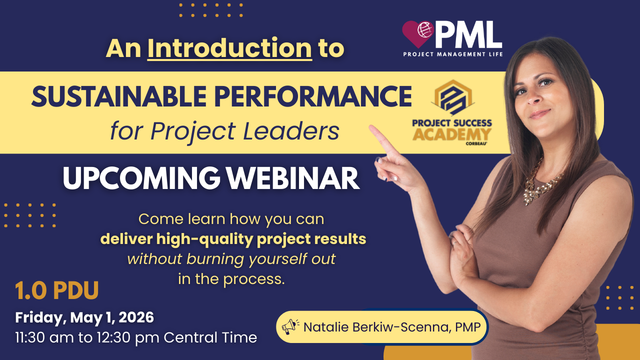
If you’re ready to build a more sustainable approach to performance, join us for our free webinar on May 1, 2026:
“An Introduction to Sustainable Performance for Project Leaders”
In this session, you’ll learn:
- Why traditional performance strategies lead to burnout
- The core skills of sustainable performance
- What sustainable performance looks like when you start making immediate, practical shifts in your work
Save your spot and take the first step toward a more sustainable way of working.

Who is Project Management Life (PML)?
Project Management Life (PML) is a growing community focused on helping project leaders build sustainable performance through community, content, virtual retreats, courses, and transformational learning experiences.
We share exclusive content around project management, career and personal branding, health and well-being, self-care, and so much more. PML offers a space to connect, recharge, and discover new ways to live your best life.
We founded PML on the idea that we can inspire each other with stories of success and valuable lessons learned, empower each other with career advice and resources to thrive both personally and professionally, and support each other to achieve a fulfilling work-life balance and focus on our health and well-being.
By living our best life, we bring our best selves to our projects, our teams, our loved ones, and the world.
Join the PML Community
The PML Community is a community of project managers and like-minded professionals supporting each other. Whether you’re a new or experienced project manager, this is a place where we can connect, learn, celebrate, and support one another.
The PML Community Newsletter is free, and jam-packed with exclusive content about project management, career growth and personal branding, health and well-being, personal self-improvement, professional development, work-life balance, and more. If you’re ready to go deeper with PML, we also have our PML Membership if you’re looking for more great content to live your best life. Check out our PML Membership page to learn more.
Join us today, and don’t miss out!
Share this Blog Post:
Check out some of PML’s other blog posts:
- An Introduction to Sustainable Performance: Why Project Leaders Need a New Way to Think About Performance
- Setting the Year Up for Success: How Project Managers Can Set Personal Goals and Resolutions
- A Thankfulness List for Project Managers
- Celebrating Project Managers: Building the Past, Shaping the Future
- “Great Communicator” is Written on Your Resume – But Does the Hiring Manager Reviewing it Agree?
- Fun Ways to Sneak Exercise into Your Busy Day: Let’s Get Moving, Project Managers!
- The Power of Focus: How Project Managers Get More Done in Less Time and Avoid Burnout
- Leveraging Storytelling: How Your Project Management Resume Can Stand Out and Shine
- Salary Negotiation for Project Managers: How to Not Leave Money on the Table
- Developing a Great Meeting Agenda: A Project Manager’s Essential Tool for Leading Effective Meeting Discussions
- From Chaos to Calm: How Project Managers Can Manage Stress (and Avoid Burnout)
- How to Manage a Project: A Step-by-Step Guide to Leading a Project from Start to Finish
- Smart Snacking: Healthy Snack Options for Busy Project Managers On-the-Move
- Breaking into Project Management: How to Find Your First, Entry-Level Project Manager Role
- The Secrets to a Strong Project Kick-Off Meeting: How to Effectively Launch Your Next Project